 Skip to content
The Richardson's Trading Post Learning Center

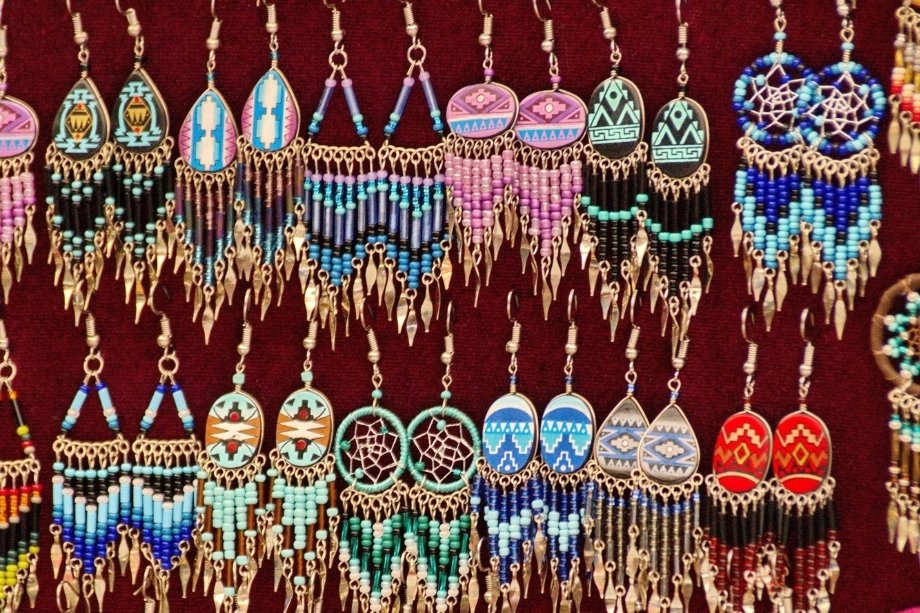
Woven with Intention: Understanding Native American Beadwork Earrings
While the gleam of silver and turquoise often defines the Southwest, there is another medium that is equally iconic: the seed bead. Native American beadwork earrings are a testament to the artist’s patience, where thousands of tiny glass beads are woven together to create wearable masterpieces. From the vibrant “fringe” styles of the Plains to the intricate “brick stitch” patterns of the Southwest, these pieces offer a lightweight, colorful alternative to traditional metalwork.
A History of the Needle
Beadwork has been a part of Indigenous culture long before the arrival of glass beads from Europe. Historically, ancestors used natural materials like shell, stone, bone, and dried seeds. When “seed beads” (tiny glass beads) were introduced via trade in the 1800s, it sparked an artistic revolution. Artists could suddenly achieve a level of detail and color depth that was previously impossible. Today, traditional Native American earrings made with beads continue this legacy, blending ancestral patterns with contemporary fashion.
Styles of the Craft: From Hoops to Fringe
When searching for handmade Native American jewelry, you will find that beadwork earrings fall into several distinct architectural styles:
- Beaded Hoop Earrings: This style involves weaving beads directly onto a circular frame. It requires a high degree of tension and precision to ensure the pattern remains symmetrical as it curves around the hoop.
- Fringe and Shoulder-Dusters: Perhaps the most dramatic style, these earrings feature long “tails” of beads that hang vertically. The hallmark of a master-level fringe earring is its “fluidity”—the beads should hang like silk and move gracefully with the wearer.
- Brick Stitch and Peyote Stitch: These are technical terms for how the beads are locked together. These stitches create a stiff, fabric-like surface that allows the artist to “paint” intricate geometric or floral native american earrings designs with incredible resolution.
The Signature of the Artist
Because these are handmade Native American earrings, no two pairs are ever truly identical. Artists often choose colors based on traditional significance—white for the east, blue for the south, yellow for the west, and black for the north—or use contemporary palettes that reflect the changing seasons of the high desert. The precision required is immense; a single misplaced bead can throw off the entire geometric alignment of the piece.

