 Skip to content
The Richardson's Trading Post Learning Center

From Coins to Classics: The Three Phases of the Navajo Concho Belt
In the world of Southwestern adornment, few items carry as much presence as the Navajo concho belt. Derived from the Spanish word concha (meaning shell), these belts have evolved from simple, hammered silver discs into some of the most intricate examples of Native American silver belts in existence. For the serious collector, understanding the “Three Phases” of concho development is essential to appreciating the technical mastery behind each piece.
The First Phase: Raw and Radiant (1860s – 1890)
The earliest native american concho belts were a triumph of resourcefulness. Before the availability of commercial silver sheets, Navajo smiths hammered out silver pesos and dollars into thin, circular discs.
The hallmark of a First Phase concho belt is the diamond-shaped slot cut out of the center. Because the smiths had not yet learned to solder “loops” onto the back of the silver, the leather belt had to be woven through these central slots. These early pieces are characterized by a clean, minimalist aesthetic—often featuring simple “bright-cut” engraving around the edges and a soft, coin-silver patina.
The Second Phase: The Birth of the Copper Loop (1890 – 1900)
As silversmithing tools and techniques advanced, artists discovered how to solder copper loops (lugs) onto the back of the conchos. This was a revolutionary shift; it meant the leather no longer had to pass through the front of the silver, allowing the artist to use the entire surface of the disc for decoration.
Antique Native American belts from the Second Phase began to feature more complex stamp work and repoussé (metal hammered from the back to create a raised design). This era represents a transition from “utilitarian” to “ornamental,” as the silver surfaces became canvases for intricate geometric storytelling.
The Third Phase: Turquoise and Butterflies (1900 – Present)
By the turn of the 20th century, the concho belt reached its most recognizable form. This era introduced two major design elements: turquoise and “butterflies.”
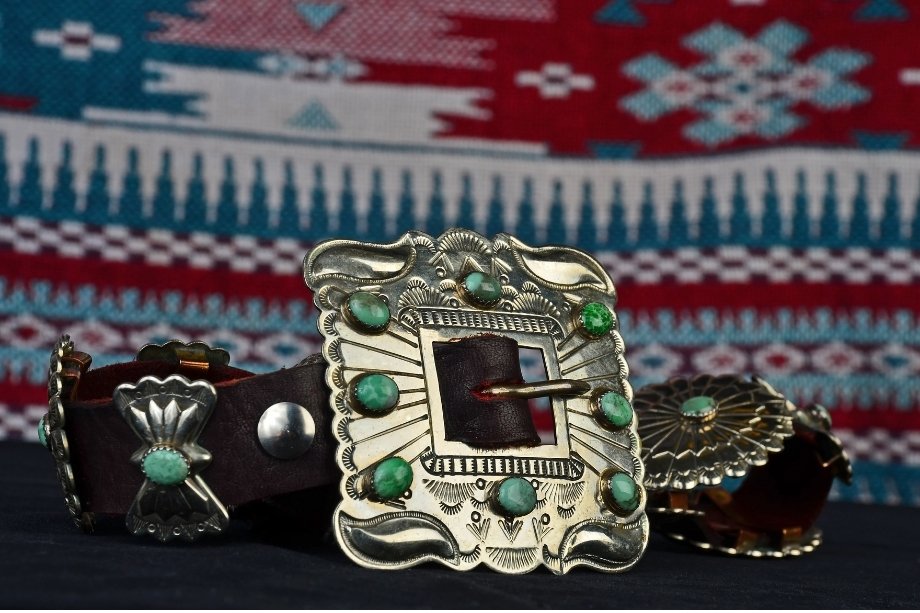
A turquoise concho belt from this period often features a large center stone in each concho. Furthermore, smiths began adding vertical silver spacers between the large discs, known as “butterflies” because of their winged shape. Today, master smiths continue to push this phase forward, creating handmade native american belts that combine heavy-gauge silver with museum-grade stones like Morenci, Bisbee, or Lander Blue turquoise.
An Investment in Wearable History
Whether it is the rugged simplicity of a First Phase design or the vibrant blue of a modern navajo concho belt, these pieces are more than just accessories. They are an investment in a craft that has survived and thrived for over 150 years. Each belt tells the story of the smith’s steady hand and the evolution of a culture that turned currency into fine art.
Own a Piece of the Evolution The transition from the simple diamond-slot conchos of the 1800s to the turquoise-encrusted masterpieces of today represents a unique lineage of American artistry. Because each phase is so distinct, these belts remain among the most sought-after investments for serious collectors.
We invite you to browse our current collection of Native American belts to find a piece that resonates with your style. If you are looking for a specific historical phase or a work by a particular master silversmith, please reach out to us to see what we currently have available in our gallery.

